
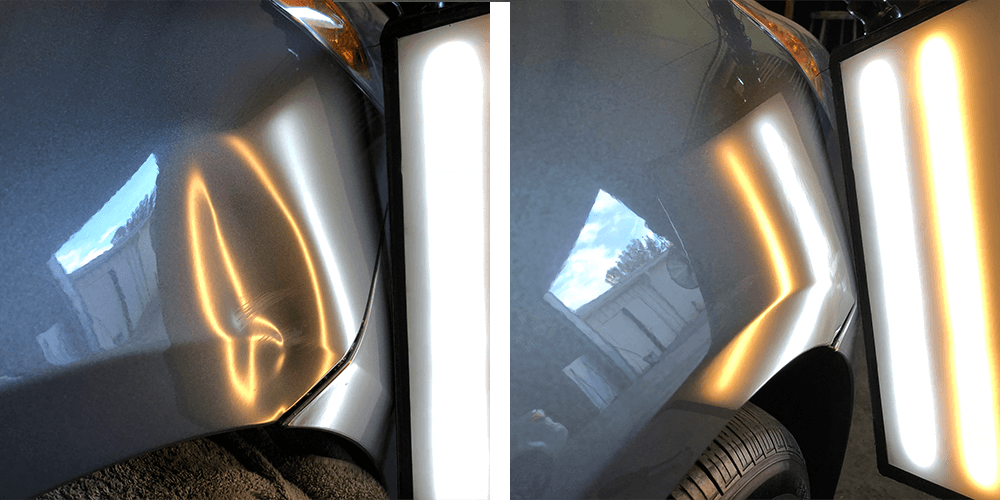
Two door dents that look similar can receive different repair quotes because appearance does not reveal every repair constraint. Panel bracing, access, paint condition, depth, and location can all affect the work required. Even dents with identical diameters may need different tools, techniques, and labor.
If you’re comparing estimates in Charlotte, focus on what each repair involves rather than assuming dent size determines the price. Understanding why door dent repair quotes differ helps you compare the proposed methods, identify possible additional charges, and choose an appropriate repair without relying on price alone.
Why Dent Diameter Is Only One Part of a Quote
Dent diameter is one factor technicians consider when preparing an estimate, but it does not tell the complete story.
Two dents measuring approximately two inches across may appear equally minor. However, their depth, position, and the way the metal has deformed can make one substantially more difficult to repair.
Two Similar Door Dents With Different Repair Requirements
Consider two vehicles with dents of approximately the same diameter.
Vehicle A: Shallow Dent in the Center of the Door
The first vehicle has a shallow, rounded dent in the middle of its front door. The original paint remains intact, and the damaged area is relatively accessible from behind.
A technician may be able to position specialized tools behind the panel and gradually restore its original shape.
Because the dent is shallow and accessible, the repair may involve fewer complications.
Vehicle B: Deep Dent Near the Door Edge
The second vehicle has a dent of similar diameter, but it sits close to the rear edge of the door. The impact created a sharper depression, and internal reinforcement limits access behind the metal.
The technician may need additional tools, a different repair technique, or limited interior disassembly.
Although both dents appear similar in photographs, Vehicle B may require considerably more work.
This explains why two same-size dents can receive different estimates.
How Does Dent Depth Affect Repair Complexity?
Dent depth often matters as much as diameter.
A shallow depression may retain a relatively smooth shape, making it easier to gradually reshape the metal.
A deeper dent can create concentrated stress and sharper contours.
The technician must evaluate whether the metal has stretched and whether its original shape can be restored without conventional bodywork.
Factors influencing the assessment include:
-
How sharply the metal bends at the impact point.
-
Whether the dent contains a crease.
-
Whether the surrounding panel has developed raised areas.
-
How the damage affects the door’s original body line.
-
Whether the paint remains intact.
A small, sharp dent can sometimes require more intricate work than a larger, shallow depression.
Does a Dent on a Body Line Cost More?
It can.
Body lines are the defined contours running across vehicle panels. They contribute to the vehicle’s appearance and create transitions between different panel shapes.
When a dent crosses a body line, the technician must restore both the damaged surface and the original contour.
This may require more precise manipulation than repairing a smooth, relatively flat section.
For that reason, small dent repair cost should not be evaluated using diameter alone. Understanding how to assess the severity of a small dent can help explain why even minor-looking damage may require more detailed work.
Access and Reinforcement Behind the Door
Paintless dent repair often involves reaching behind the damaged panel and applying controlled pressure with specialized tools.
However, vehicle doors contain more than an exterior metal skin.
Internal reinforcement, window mechanisms, wiring, locks, and safety components can restrict access.
These details may not be visible when you examine a dent from outside.
Why Does Panel Access Change a Repair Quote?
An accessible dent may allow the technician to work through an existing opening without substantial disassembly.
A dent behind reinforcement or mechanical components can require additional planning.
Depending on vehicle construction, the technician may need to:
-
Remove selected interior door trim.
-
Use specialized tools to reach restricted areas.
-
Work around window mechanisms or reinforcement.
-
Consider an exterior pulling technique.
-
Reinstall disturbed components and check their operation.
Additional access work can affect labor requirements and the final estimate.
However, interior disassembly is not automatically required whenever a dent appears difficult to reach.
The technician should evaluate the vehicle before selecting an access method.
Does a Dent Near a Door Edge Cost More to Repair?
A dent near a door edge may be more difficult to repair than one in the center of the panel.
Door edges often contain folded metal, seams, or reinforcement that limits tool movement.
The surrounding metal may also be less flexible because of the panel’s construction.
A technician working near these areas may have less room to position tools and control pressure.
This does not mean every door-edge dent costs more.
The actual difficulty depends on its location, depth, available access, and vehicle design.
How Do Internal Door Braces Affect PDR?
Door reinforcement braces support the panel and contribute to the door’s structural design.
When a dent sits directly over a brace, there may be insufficient room to place a repair tool behind the damaged metal.
The technician might consider exterior glue pulling if the paint condition allows it.
However, this method is not suitable for every dent or painted surface.
Reinforcement components should not be modified simply to gain access.
A proper estimate should reflect the approved repair approach rather than assume all door dents can be reached through the same opening.
Can Vehicle Design Affect the Estimate?
Yes.
Two vehicles with similar damage may have different internal door construction.
Panel material, reinforcement placement, window assemblies, and trim design can affect how the technician reaches the damaged area.
Aluminum and steel panels also respond differently to manipulation.
These differences help explain why a simple PDR cost per dent comparison may not accurately represent the work involved. Learning about modern paintless dent repair techniques can provide additional context about the methods technicians use for different types of damage.
Paint History and Repair Complexity
Paint condition plays an important role in determining whether a dent qualifies for paintless dent repair.
PDR is designed to reshape damaged metal while preserving a suitable existing finish.
However, cracked paint, previous refinishing, and underlying body filler can change the available repair options.
Why Does Previous Paintwork Matter?
A factory-painted door and a previously repainted door may respond differently to certain techniques.
For example, exterior glue pulling places controlled stress on the painted surface.
If a refinished panel has poor paint adhesion, pulling may cause the coating to lift or separate.
Previous body filler can also complicate the repair because it does not behave like undamaged metal.
Before receiving a quote, tell the technician if the door has undergone previous bodywork.
This information can help identify potential limitations before repairs begin. For more context, learn about whether paintless dent repair can damage paint.
Can Two Dents With Intact Paint Still Cost Different Amounts?
Yes.
Even when both dents have intact paint, their shapes and underlying metal conditions may differ.
One dent may be smooth and shallow. Another may contain a sharp center, stretched metal, or raised edges.
The second repair may require more detailed reshaping to restore the panel’s contours.
Repair difficulty also depends on whether the technician can reach the damaged area without disturbing surrounding components.
For additional information about general pricing considerations, see Paintless Dent Repair Cost: Understanding the Factors.
When Is Conventional Repair Necessary?
Some dents are unsuitable for paintless repair.
Conventional body repair may be considered when damage includes:
-
Cracked or missing paint.
-
Severely stretched metal.
-
Significant panel deformation.
-
Previous filler that interferes with repair.
-
Damage that cannot be acceptably corrected using PDR.
Conventional repairs may involve refinishing or additional materials, creating a different scope of work.
When comparing paintless dent repair cost with conventional repair pricing, confirm that both estimates address the same damage and expected outcome. You can also review the differences between conventional repair and paintless dent repair to better understand when each approach may be appropriate.
Comparing Scope, Exclusions, and Expected Finish
The lowest estimate does not necessarily represent the same service as a higher quote.
Two providers may recommend different repair methods, include different preparation work, or identify separate limitations.
Before choosing a repair, ask for enough information to understand what each estimate covers.
What Should a Written Dent Repair Quote Include?
A useful dent repair cost estimate should identify:
-
Damage location: The specific door and affected area.
-
Repair method: Whether the work involves PDR or conventional repair.
-
Access requirements: Whether trim removal or specialized access is anticipated.
-
Included labor: The work covered by the quoted amount.
-
Additional charges: Any applicable materials, parts, taxes, or other fees.
-
Exclusions: Damage or services not included in the estimate.
-
Expected finish: Any limitations affecting the anticipated appearance.
-
Estimate conditions: Circumstances that could require a revised price.
You should also clarify whether the quote is preliminary or based on a completed inspection.
Photographs can help with initial assessment, but they may not reveal every access restriction or previous repair.
How Should You Compare Two Different Quotes?
Compare the proposed repair work rather than looking only at the total.
For example, one estimate may assume that the technician can reach the dent through an existing opening.
Another may include limited trim removal because the provider identified an obstruction.
Both quotes may be reasonable under their respective assumptions.
Ask each provider to explain how the proposed method addresses the dent’s depth, location, and access requirements.
If a quotation is substantially lower, determine whether it excludes necessary preparation or relies on a different repair outcome.
For more information on the estimating process, read How Do You Get an Estimate to Fix a Dent in a Car?.
Should You Expect Every Dent to Disappear Completely?
Not every dent can be restored to the same standard.
Paintless repair can produce excellent results on suitable damage, but severe stretching, sharp creases, and restricted access may affect the outcome.
A technician should explain any known limitations before repairs begin.
Ask whether the quoted service aims for complete restoration or whether some visible irregularity may remain.
This distinction is particularly important when comparing estimates that appear to offer identical services.
What if the Estimate Changes After Inspection?
An estimate may change when additional damage or access restrictions become apparent.
For example, the technician might discover previous body filler or reinforcement blocking the planned repair method.
Before authorizing additional work, request an explanation of the findings and the revised scope.
You should understand what changed, why additional work is necessary, and how it affects the original estimate.
For more information about Piedmont Dent Repair’s approach to estimates, visit our Cost page.
Frequently Asked Questions
Why Do Similar Dents Have Different Repair Prices?
Similar dents can require different amounts of work because of depth, location, paint condition, and panel accessibility. Two dents with identical diameters may require different techniques or additional labor.
Does a Dent Near a Door Edge Cost More to Repair?
It can. Door edges often have restricted access, folded metal, or reinforcement. These features may increase repair difficulty, although the actual estimate depends on the individual dent.
Can Panel Access Change a Dent Repair Quote?
Yes. A dent behind reinforcement or window components may require specialized tools or additional access work. An accessible dent may involve fewer repair steps.
What Should a Written Dent Repair Quote Include?
Your quote should identify the repair method, included work, anticipated access requirements, additional charges, exclusions, and expected finish. It should also explain when the estimated amount could change.
Requesting an Assessment Before Choosing a Quote
If you’ve received different quotes for similar door dents, Piedmont Dent Repair can help you understand the repair requirements. We provide professional paintless dent removal in Charlotte and assess each dent based on its condition, location, and accessibility.
Send us clear photographs or arrange an inspection to discuss your options. We’ll review the damage, explain the proposed repair method, and provide an estimate based on the work your vehicle needs before you decide how to proceed.