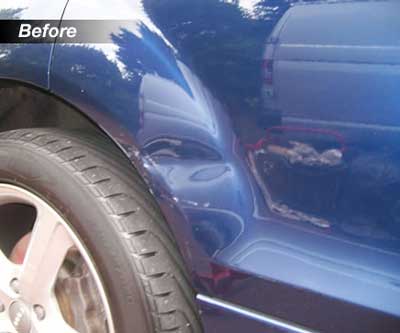
Some dents in an aluminum hood can be repaired with paintless dent repair, but the material and hood construction make careful assessment important. The technician needs to confirm that the hood is actually aluminum, inspect the paint, evaluate how sharply the metal was deformed, and determine whether reinforcement underneath the hood limits access.
An aluminum hood does not automatically need replacement because it has a dent. Paintless dent repair may be an option when the finish is intact, the deformation is manageable, and the metal can be reshaped safely. Aluminum behaves differently from steel, so location, stretching, work hardening, paint condition, and access all matter.
How Aluminum Hood Construction Affects Assessment
Before deciding how a hood dent should be repaired, the first question is basic: is this particular hood actually aluminum?
Modern vehicles can combine steel, aluminum, composites, and other materials. Material choices may also vary by model year or trim, so the panel should be verified rather than judged by appearance alone.
Once aluminum is confirmed, the repair assessment changes because the material behaves differently from conventional steel. Aluminum can become more work-hardened as it is damaged and manipulated. Areas around body lines, crowns, and other stamped contours may resist straightening more than a similar-looking dent in an open section of the panel.
This does not mean aluminum cannot be repaired. It means the technician needs to understand how much movement the panel can tolerate and how the metal responds throughout the repair.
For a broader look at the tools, panel behavior, and methods involved in PDR, review Piedmont Dent Repair’s Materials & Techniques information.
Is Aluminum Dent Repair Different From Steel Dent Repair?
Yes. The overall goal may be similar, but a technician cannot assume aluminum will respond exactly like steel.
Aluminum may work-harden as it is moved. Damage location, panel design, backside access, and the amount of deformation all matter when deciding whether an aluminum exterior panel can be restored without refinishing.
Controlled technique is especially important. A technician may need to make many small adjustments rather than trying to move a large area at once. The skill lies in reading how that specific panel responds to pressure, pulling, and changes in contour.
Vehicle manufacturers may also publish model-specific repair limitations that affect whether PDR is appropriate and how access can be obtained.
Paint Condition and Signs of Stretched Metal
Paint condition is one of the clearest factors separating a strong PDR candidate from a repair that may require refinishing.
Paintless dent repair is intended to restore the metal while preserving the existing finish. If the paint remains intact, there may be an opportunity to reshape the hood without body filler or repainting. If the impact cracked, split, or removed paint, returning the metal to shape will not restore the finish.
A technician may inspect for chips, cracks, scrapes through the coating, sharp folds, distortion around the impact, and signs that the panel has been refinished before.
Paint that looks intact still needs close inspection when the dent is sharp or heavily stressed.
Stretched Aluminum Can Limit PDR
A dent does more than push metal inward. Depending on the force and shape of the impact, the panel can also stretch.
That distinction matters because excessively stretched aluminum may not return cleanly to its original contour through PDR alone.
Signs of more challenging deformation can include:
- A very deep center
- A hard crease
- A sharply defined impact point
- Metal folded around an edge
- Large areas of distortion surrounding the main dent
- Instability in the panel after deformation
The overall diameter of the dent is only part of the decision. A broad, shallow depression can sometimes be more workable than a much smaller dent with a sharp impact point.
Why Hood Bracing Changes Tool Access
The top of a hood may look like one uninterrupted panel, but the underside often contains reinforcement that gives the hood stiffness and structure.
That reinforcement can create double-layered sections where a PDR tool cannot reach directly behind the visible dent. A dent in an open section may provide useful backside access, while a similar dent directly above a brace may not.
A brace does not automatically make the damage impossible to repair. Depending on the vehicle and dent, a technician may be able to reach the area through an existing opening, work around reinforcement, or use an appropriate exterior pulling technique.
The technician still needs to consider paint condition, stretch, depth, previous repairs, and manufacturer restrictions before deciding whether PDR remains appropriate.
Why Dent Location Matters on an Aluminum Hood
Not every part of a hood behaves the same way.
A dent in the broad center section can be very different from one located on a stamped body line, along a strong crown, close to a folded edge, beside the latch area, directly above reinforcement, or near a sharply formed contour.
Body lines and crowns are already strengthened by the stamping process. When they are damaged, the metal may become more resistant to straightening.
That is why a close-up of the dent alone may not tell the whole story. A technician also needs to see where the damage sits on the hood and how the surrounding panel has changed.
Can a Large Aluminum Hood Dent Be Repaired With PDR?
Potentially.
Large dent removal is not decided by diameter alone. A technician may evaluate overall size, depth, sharpness, paint condition, metal stretch, the number of creases, damage location, panel access, reinforcement, and manufacturer repair limitations.
This is why “large dent” is not a diagnosis. The technician needs to inspect how the aluminum has moved.
For broader guidance on damage that may fall outside normal PDR limits, see What Dents Cannot Be Fixed With Paintless Dent Repair?.
Does an Aluminum Hood Dent Require Replacement?
No, not automatically.
Cosmetic aluminum damage can sometimes be repaired rather than requiring a new hood. Replacement becomes more likely when the metal is severely stretched, torn, sharply folded, or otherwise damaged beyond what can be restored to the proper contour.
There is also a middle category: the hood may be repairable, but not with paintless dent repair.
Conventional aluminum bodywork may sometimes restore a hood when PDR alone is not suitable. That can involve metal finishing, refinishing, or other procedures appropriate to the vehicle and extent of damage.
The repair decision should come after evaluating the actual panel, not from the word “aluminum” alone.
PDR Versus Bodywork or Hood Replacement
It helps to think of the repair decision as three possible paths.
Paintless Dent Repair
PDR may be appropriate when the paint is intact, the dent is within workable limits, metal stretch is manageable, the technician has suitable access, and vehicle-specific guidance does not rule out the method.
The main advantage is the possibility of preserving the existing finish.
Conventional Body Repair
Traditional body repair may make more sense when the paint is damaged, additional metal finishing is needed, or PDR cannot restore the correct panel shape by itself.
A repairable aluminum hood does not have to remain a paintless repair if refinishing is the better option.
Hood Replacement
Replacement may be considered when damage exceeds what can reasonably be restored or when manufacturer procedures specify replacement for the type of damage involved.
The goal is not to force every dent into one method. It is to choose the approach that best fits the panel and the damage.
Why Technician Experience Matters With Aluminum
Aluminum repair requires material-specific knowledge and technique.
A technician should understand damage analysis, repair-versus-replace decisions, aluminum-specific tools, panel access, and how the material reacts during repair. Backside protection may also need attention if tools disturb protective coatings.
When discussing an aluminum hood repair, ask whether the technician regularly works with aluminum panels and how they determine whether a paintless approach is appropriate.
Piedmont Dent Repair provides professional paintless dent removal in Charlotte and surrounding service areas, but the suitability of a particular aluminum hood still depends on the actual damage and vehicle.
Questions to Ask Before Approving an Aluminum Hood Repair
Have you confirmed that this hood is aluminum?
The repair plan should be based on the actual panel material.
Is the original paint still suitable for PDR?
Ask whether there are cracks, chips, previous refinishing, or other finish concerns.
Does the dent appear stretched?
The technician should be able to explain how depth and shape affect repairability.
Is there reinforcement underneath the dent?
Bracing can affect tool access and repair technique.
Can the damage be reached appropriately?
Access should respect panel construction and manufacturer procedures.
Does the manufacturer limit this repair?
Vehicle-specific guidance should take priority.
Is PDR the best option?
The repair method should fit the damage.
What requires an in-person inspection?
Photos cannot reveal every detail of access, previous repairs, or metal response.
Can Aluminum Hood Dents Be Repaired With PDR?
Yes, some can.
An aluminum hood with intact paint, manageable deformation, and workable access may be a candidate for paintless dent repair. The technician still needs to verify the panel material, inspect for stretching and sharp folds, evaluate reinforcement underneath the hood, and check any vehicle-specific repair requirements.
Is Aluminum Dent Repair Different From Steel Dent Repair?
Yes.
Aluminum has different material behavior and can become work-hardened as it is damaged and manipulated. That can affect the technique, effort, and limits of repair.
A technician should have appropriate aluminum repair knowledge rather than assuming a steel repair method will transfer directly.
Can a Dent Above a Hood Brace Be Repaired?
Possibly.
A hood brace can restrict direct access from behind the dent, but a technician may have other appropriate access or pulling options.
The final decision depends on the dent, paint, panel construction, material, and manufacturer guidance.
Does an Aluminum Hood Dent Require Replacement?
Not simply because the hood is aluminum.
Some cosmetic aluminum damage can be repaired, while more severe stretching, folds, tears, or vehicle-specific restrictions may make conventional repair or replacement more appropriate.
Get an Aluminum Hood Dent Assessment in Charlotte
If you have a dent in an aluminum hood, the most useful next step is to have the actual panel assessed rather than assuming it needs repainting or replacement.
A technician should confirm the hood material and evaluate paint condition, dent depth, sharpness, metal stretch, hood bracing, tool access, panel contours, and any manufacturer-specific limitations.
Piedmont Dent Repair serves Charlotte and surrounding areas with paintless dent repair for qualifying damage. Send clear photos of the full hood, the dent itself, and an angled view that shows panel distortion.
From there, the technician can determine whether the hood appears to be a reasonable PDR candidate or whether an in-person inspection is needed before recommending paintless repair, conventional bodywork, or replacement.
[/fusion_text][/fusion_builder_column][/fusion_builder_row][/fusion_builder_container]